Saturday, July 19, 2008

Sticky Fingers Roundup

Sticky Fingers Roundup


1. "Brown Sugar" – 3:50
2. "Sway" – 3:52
3. "Wild Horses" – 5:44
4. "Can't You Hear Me Knocking" – 7:15
5. "You Gotta Move" (Fred McDowell/Rev. Gary Davis) – 2:34
6. "Bitch" – 3:37
7. "I Got the Blues" – 3:54
8. "Sister Morphine" (Mick Jagger/Keith Richards/Marianne Faithfull) – 5:34
9. "Dead Flowers" – 4:05
10. "Moonlight Mile" – 5:56

The Stones are really on a roll: Beggars Banquet, Let It Bleed, and now Sticky Fingers. The biggest change came with the addition of Mick Taylor – finally the band had a world class lead guitar player, and as "Knocking" and "Moonlight Mile" proved, he had some interesting rhythm ideas as well.

The album is unusual in that it features only three rockers – the rest of the songs are mostly mellow, if not contemplative.

Some background info from Wikipedia:


Although sessions for Sticky Fingers began in earnest in March 1970, they had done some early recording at Muscle Shoals Studios in Alabama in December 1969 and "Sister Morphine", cut during Let It Bleed's sessions earlier in March of that year, would be held over for this release. Much of the recording for Sticky Fingers was effected with The Rolling Stones' mobile studio unit in Stargroves during the summer and fall months in 1970. Early versions of songs that would appear on Exile on Main St. were also routined during these sessions.
With the end of their Decca/London association at hand, The Rolling Stones would finally be free to release their albums (cover art and all) as they pleased. However, soon-to-be-ex-manager Allen Klein (who took over the reins from Andrew Loog Oldham in 1965 so that Oldham could concentrate on producing the band), dealt the group a major blow when they discovered - to their horror - that they had inadvertently signed over their entire 1960s copyrights to Klein and his company ABKCO, which is how all of their material from 1963's "Come On" to Get Yer Ya-Ya's Out! The Rolling Stones in Concert has since come to be released by ABKCO Records. The band would remain incensed with Klein for decades over the swindle.

When Decca informed The Rolling Stones that they were owed one more single, they cheekily submitted a track called "Cocksucker Blues" - which was guaranteed to be refused. Instead, Decca released the two-year-old Beggars Banquet track "Street Fighting Man" while Allen Klein would have dual copyright ownership - with The Rolling Stones - of "Brown Sugar" and "Wild Horses".

Sticky Fingers may just be the band's most drug-drenched album, as well over half of the songs mention drug use, while the rest merely allude to it. Some final overdubbing and mixing in January 1971, found the album complete and preceded by "Brown Sugar" that March, which reached #1 in the US and #2 in the UK. Appearing in April on their new Rolling Stones label (with distribution by WEA Music), Sticky Fingers was rapturously-received and hit #1 worldwide, beginning an uninterrupted string of eight consecutive chart-topping US studio albums. "Wild Horses", covered by Keith Richard's friend Gram Parsons with The Flying Burrito Brothers, was the second single in the US only, making the Top 30.

Moonlight Mile

Stick Fingers
Track 10
"Moonlight Mile" – 5:56


The story goes that Mick Taylor's first major contributions were on "Sway" and "Moonlight Mile", two songs the Stones had already recorded rudimentary demos of. Taylor came in and, with Jagger, finished the songs off, playing all the guitars as well as arranging the songs (including adding the string sections). Taylor later said that he quit the band because of Jagger and Richard's refusal to grant him songwriting credits.

Keith does not play on "Moonlight Mile", and although the lead acoustic riff is frequently credited to Jagger, it is pretty clearly Taylor's work. Here, we get an idea of what the Stones would have sounded like without Keith – it turns out they would have sounded exactly like the Beatles, complete with a double-tracked lead vocal.

The lyrics fall into the whiny "being a rock star is so hard!" genre that Mick dipped into on occaiasion. They do have a particular grace and facility on "Moonlight Mile", suggestive of Lennon:

Made a rag pile of my shiny clothes.
Gonna warm my bones, gonna warm my bones.
I got silence on my radio.
Let the air waves flow, let the air waves flow.

Wednesday, July 16, 2008

Dead Flowers

Sticky Fingers
Track 9
"Dead Flowers" – 4:05


[Download]

You all know this one. A classical midtempo country groove, some tasteful string bending, a catchy melody. That's the way you write a drug song: you make it too good to ignore.

Steve Earle liked the song too:
Dead Flowers - Steve Earle

Tuesday, July 15, 2008

Sister Morphine

Sticky Fingers
Track 8
"Sister Morphine" (Mick Jagger/Keith Richards/Marianne Faithfull) – 5:34


As soon as you're born they make you feel small
By giving you no time instead of it all

Oh, wait. That's a different song. Sorry.

"Sister Morphine" was written (or co-written – the record is a little unclear) by Marianne Faithfull, who was a famous junkie in the sixties. She also apparently had a sideline as a singer/songwriter. Given that description, you won't be surprised to learn that I haven't heard her version of the song, nor have any desire to hear it ever (I'll put it down at the end of this post). The Stones' version of "Sister Morphine" is a drag, slow and blue, simulating, I suppose, the experience of junkyism in musical form.

Listen: I am a 37 year old middle class white guy with a house, job, and a dog. I'll go out on weekends and knock back a few pints with friends. I give money to homeless people in an attempt to curb my innate liberal guilt. I watch sports on TV. I don't want to hear songs about how some famous rich cunt in the sixties ruined her own fucking life, okay? I just don't give a shit.

Sunday, July 13, 2008

I Got the Blues

Sticky Fingers
Track 7
"I Got the Blues" – 3:54


I'd forgotten that Sticky Fingers was such a ballad oriented album – "Sway", "Wild Horses", and now "I Got the Blues".

I'd also forgotten what a great song this is – a letter-perfect ripoff of an Otis Redding soul balled, complete with a Steve Cropper arpeggio into, B3 solo (by Billy Preston, moonlighting from his gig over at Abbey Road Studios), and Otis horns (by the previously dissed – regretfully, may I add – Bobby Keys and Jim Price). In an earlier entry I wrote that there comes a point when commitment turns into caricature, when homage turns into parody. It's easy to understand how someone could think that "I Got the Blues" maybe crossed the line, but I'm inclined to give the Stones a break here. Unlike some of their other attempts to mimic their heroes and influences, this track is notable for how well it is executed – not only did they manage to write a song Otis could have sung, they played it pretty much exactly the way he would have recorded it.

Here they are performing the song live at the Marquee Club in London on March 26, 1971. Otis had been dead for three years.


Bitch

Sticky Fingers
Track 6
"Bitch" – 3:37


Unlike many other canonical rock bands, the Stones didn't really go in for single-string riff rock. Whereas Zeppelin had dozens of songs in that style (eg "Heartbreaker", "Whole Lotta Love", "Good Times, Bad Times", "Black Dog"), "Bitch" is the only Stones song I can think of off the top of my head.

It's not a particularly good song, although the riff itself has a kind of satisfying inevitability to it. One of the things that's always bugged me about the track is the horns: they sound like shit. I don't know why that is. Maybe I'm just used to the contemporaneous horn charts of Stax and Muscle Shoals and on all the R&B/Soul recordings of the era, which represent the pinnacle of horns on pop/rock recordings. Compare, say, Aretha's version of "The Weight", recorded the year before the Stones recorded "Bitch" (the horns kick in on the second verse):


Hear the difference? The horn charts on "The Weight" act as a counterpoint to the melody, and take off at odd angles, rhythmically and harmonically. The three horns on "Bitch" (sax by Bobby Keys, Jim Price on trumpet and trombone) play in unison with each other and with the main guitar riff. I've never liked the sound of unison horns, which sound totally artificial to my ears. (Don't the "Bitch" horns sound exactly like the early digital synthesised horns of the 80s?) I think that's what's always bugged me about this song.

Anyway, here's a great live recording of "Bitch", from a concert in Houston, Texas, June 25 1972.

Friday, July 11, 2008

You Gotta Move

Sticky Fingers
Track 5
"You Gotta Move" (Fred McDowell/Rev. Gary Davis) – 2:34


This is the old blues number "You Got to Move", recorded by any number of artists over the years and on YouTube, but associated primarily with its "composer" Mississippi Fred McDowell. Composer in quotes – it's hard to know if anyone actually composed any particular blues song, since so many of the melodies and lyrics were floating around in the public domain and had a habit of turning up over and over again in different songs. Anyway, the Stones took a crack at it for some reason, with Mick Taylor on the 12-string playing slide and Mick Jagger singing in blackface.

Anyway, enough about the Stones. Back in high school, their version led me indirectly to the version by the Five Blind Boys of Alabama, a gospel group whose career stretches back to the depression, who spent a lot of time on my turntable over the last two decades. This is the second time Blogging the Stones has come across the group (previously on "The Last Time"), and I've got two songs lined up for you today. Here they are singing "You Got To Move" (click title to download).


Here they are singing one of my favourite gospel compositions, "Here Am I":

Can't You Hear Me Knocking

Sticky Fingers
Track 4
"Can't You Hear Me Knocking" – 7:15


I have a class of mp3s on my hard drive tagged "intros" – that is, the best opening few seconds of songs. I created it years ago just for "Can't You Hear Me Knocking", which may be the best intro of them all. Check it out:


Isn't that the filthiest, most obscene guitar tone ever? Mick Taylor comes in a steals the whole show in the first 10 seconds with that lewd, smutty riff [*]. Sticky Fingers is Taylor's album, and "Knocking" is his song. Keith could never have come up with a riff like that – if fact, none of the other guitar heroes of the day could have: they were all single-string soloist, and the "Knocking" riff is built on those Chuck Berry double stops [**]. JustinSosa shows how it's done:


Easy to play, difficult to come up with in the first place. Kudos to you, Mr Taylor. That is a riff for the ages.

This is a song that starts with a bang and ends with a whimper – specifically, that fusiony Santana-like coda which seems to go on forever. I have no idea what they were thinking – I mean, talk about sucking the air out of the room. To remedy the situation, I have deleted that coda on my mp3, fading the song out at its natural ending.


[Download here.]


[* that lewd, smutty riff: I have now exhausted my thesaurus for synonyms of "nasty".]
[** Chuck Berry double stops: a double stop is when a guitarist solos by playing two notes on adjacent strings simultaneously by "barring" the strings with a single finger. Chuck Berry popularised (invented?) the technique on his great singles hits.]

Thursday, July 10, 2008

Wild Horses

Sticky Fingers
Track 3
"Wild Horses" – 5:44


It's Ballads Day here at Blogging the Stones. But I have to tell you, "Wild Horses" really suffers in comparison to "Sway".

I am of two minds when it comes to "Wild Horses". I can see what the band was going for, a pop-sounding ballad with a catchy sing-along chorus. It's obvious they succeeded in their attempt. But... I don't know. The tone of regret is so contrived, especially after the soul-baring on "Sway". I know, I know: it's the Stones – everything they did was contrived. But I can't help but think that "Wild Horses" was a song for their fans, and "Sway" was a song for themselves.

God, we're only three songs into Sticky Fingers and already there's two great songs I have extremely mixed feelings about. Luckily, the songs that follow seem to be less ambiguous.


Instead of posting a bunch of links to the lame covers inspired by the Stones recording, I'll just post this. Because, honestly, there is nothing funnier than Mick posing for the cameras in the studio.


And one more, from the L.A. Forum, July 13, 1975 – just for the pics!

Sway

Sticky Fingers
Track 2
"Sway" – 3:52


Welcome to the band, Mr Taylor. Make yourself at home.

Micks Jagger and Taylor finished this song off together while Keith was off doing Christ knows what. The slide solo in the middle shows off what Taylor brought to the table, and what in retrospect the band had been needing for years. Because while Keith was an excellent rhythm guitarist, inventive and versatile, his solos lacked a true identity. How the band managed to get to this point without a true lead guitar player is a credit to the strength of their songs. But once Taylor entered the studio it must have felt like the missing piece of a puzzle falling into place.

"Sway" is, I would argue, the best Stones ballad. The competition is pretty thin – ballads are not what the band did best. But "Sway" is a legitimately great song, it's dragging tempo full of regret and missed opportunities. Jagger's vocal is one of his best performances.

Live "Sway":
Sway - The Rolling Stones

Wednesday, July 9, 2008

Brown Sugar

Sticky Fingers
Track 1
"Brown Sugar" – 3:50


Listen:

Scarred old slaver knows he's doing all right.
Hear him whip the women, just around midnight.
Brown sugar, how come you taste so good?

Am I being exceedingly politically correct if I said that I find those lyrics just a little... tasteless?

Maybe I am. It was, after all, the Stones' willingness to explore these dark corners that separated them from most of their contemporaries – in a good way. And while some bands, like the Velvet Underground and the Doors, also had material that made people a little uncomfortable, the Stones alone set these lyrics to music that would fill a dance floor. Getting a room full of people to sing and dance along to a song that celebrates slavery and rape constitutes a major accomplishment, although one with Milgram Experiment overtones.

Ah, that last sentence gave it away. Yes, I find the lyrics to the song horrifying, and I can't get past them. I can't even pretend to look at "Brown Sugar" with any sort of objectivity. Attempting to do so was a mistake. Sorry.

Paris Outtakes

You'll like this: captains dead uploaded the album The Rolling Stones Paris Outtakes, Vol 1, from the Some Girls sessions. Head over there and check it out. Vol 2 follows tomorrow.


Update 7/12: As promised, captains dead did indeed post Volume 2 of the Paris Outtakes. Not only that, but that was followed with the Lonely at the Top boot. I haven't listed to that one, but the Paris Outtakes are really good. Thanks, captains dead!

Monday, July 7, 2008

Let It Bleed Roundup

Let It Bleed Roundup

1. "Gimme Shelter" – 4:32
2. "Love in Vain" (Robert Johnson) – 4:22
3. "Country Honk" – 3:10
4. "Live with Me" – 3:36
5. "Let It Bleed" – 5:34
6. "Midnight Rambler" – 6:57
7. "You Got the Silver" – 2:54
8. "Monkey Man" – 4:15
9. "You Can't Always Get What You Want" – 7:30

(See also the related single "Honky Tonk Women".)

You know, any album that opens with a track as strong as "Gimme Shelter" has got a lot going for it. But looking at the track list above, what really strikes me are the two blues numbers, which are as far apart, stylistically, as is possible within a genre so musically limited.: "Love in Vain", perhaps the darkest song of Robert Johnson's legacy, performed by the Stones as a country ballad; and "Midnight Rambler", the Stones' "blues opera", with various tempo changes and a menacing protagonist. These are the products of a group with ambition and control.

"Monkey Man" is the turd floating in the punch bowl. But whaddya gonna do, right? The rest of the album is great.

Some background from Wikipedia:

Although they had begun the recording of "You Can't Always Get What You Want" in March 1968, before Beggars Banquet had been released, recording for Let It Bleed began in earnest in February 1969 and would continue sporadically until November. Brian Jones performs on only two tracks, the autoharp on "You Got the Silver" and percussion on "Midnight Rambler". His replacement Mick Taylor also plays on two tracks, "Country Honk" and "Live With Me." Keith Richards, who had already shared vocal duties with Mick Jagger on a handful of songs ("Connection", "Something Happened to Me Yesterday" and "Salt of the Earth"), sang his first solo lead vocal on a Rolling Stones recording with "You Got the Silver."

During 1968, Richards had been hanging out in London with Gram Parsons, who had left The Byrds on the eve of their departure for a tour in the Republic of South Africa. By all accounts, Parsons had significant impact on Richards' taste in country music, and perhaps as a result of his influence, the band recorded a true honky-tonk song, "Country Honk," a more uptempo and rock and roll version of which would appear as their next single, "Honky Tonk Women." The LP track featured fiddle player Byron Berline, who worked with Parsons frequently throughout the latter's career. Parsons frequently took credit for the arrangement of "Country Honk", although both Jagger and Richards have stated that it was actually the original arrangement of the song as written and conceived while vacationing in Brazil in late 1968. In any event, Parsons had recently introduced the group to his cache of traditional country records and was at least indirectly responsible for this sea change. The singer's own cover, released on the 1976 rarities compilation Sleepless Nights, features a slightly different set of lyrics and yet another arrangement that combines elements of both Stones versions.

Recorded under trying circumstance owing to the band having reached the final impasse with Jones, the album has been called a great summing up of the dark underbelly of the 1960s.[citation needed] In addition to being one of their all-time classics, Bleed is the second of the Stones' run of four studio LPs that are generally regarded as among their greatest achievements artistically, equalled only by the best of their great 45s from that decade. The other three albums are Beggars Banquet (1968), Sticky Fingers (1971), and Exile on Main Street (1972). Steven Van Zandt said the albums represented the "Second Great Era" of the Rolling Stones and called it "the greatest run of albums in history". [1]

Released in December, Let It Bleed reached #1 in the UK (temporarily knocking The Beatles' Abbey Road out of the top slot) and #3 on the Billboard Top Pop Albums chart in the US, where it eventually went double platinum. The album was also critically well-received.

In 1998 Q magazine readers voted Let It Bleed the 69th greatest album of all time, while in 2000 the same magazine placed it at number 28 in its list of the 100 Greatest British Albums Ever. In 2001, the TV network VH1 placed Let It Bleed at number 24 on their best album survey. In 2003, it was listed as number 32 on the List of Rolling Stone's 500 Greatest Albums of All Time.

You Can't Always Get What You Want

Let It Bleed
Track 9
"You Can't Always Get What You Want" – 7:30


This song has by now been reduced to a baby boomer cliché, wistful nostalgia and sepia hues. I wonder if there's any life in it at all.

Do you ever feel that way? I'm sure you have. I used to love this song. I was born just as the sixties culture was dying, and YCAGWYW helped me understand a little of what went on during that time. But now... I don't know. All I can hear is Mick and the band embarrass themselves on stage, performing this song to an uncritical audience who doesn't want to be challenged, just reassured that some things will not change.

Isn't it funny that I can feel that way about some songs, and not about others? I don't even know where this feeling is coming from. But it stands to reason, that if there are songs that are filled with possibilities, there is the chances that these possibilities will fade over time. Why this has happened to "You Can't Always Get What You Want" and not, say, "In My Life" is a mystery to me.

I'll leave you with this clip, the second one I have posted which features Keith forgetting to bring a guitar strap to a television taping:

Monkey Man

Let It Bleed
Track 8
"Monkey Man" – 4:15


Not the Toots and the Maytals song of the same name. In case you were wondering.

This song is the very definition of album filler. The track drags itself along like a man reluctantly making his way to the dentist, barely driven by a pedestrian and forgettable Keith riff, finishing with a coda featuring Mick babbling "I'm a monkey!" over and over – I'll bet he thought they were going to fade that part out.

The only notable aspect of the song are the lyrics, which are hilariously over the top. "I'm a cold Italian pizza"? Really, Mick? That's what it's come to? "I'm a sack of broken eggs"? Jesus.

I'm a flea-bit peanut monkey
All my friends are junkies
That's not really true
I'm a cold Italian pizza
I could use a lemon squeezer
How'd you do?

I've been bit and I've been tossed around
By every she-rat in this town
Have you, babe?

Well, I'm just a monkey man
I'm glad you are a monkey woman too

I was bitten by a boar
I was gouged and I was gored
But I pulled on through
Yes I'm a sack of broken eggs
I always have an unmade bed
Don't you?

Well, I hope we're not too messianic
Or a trifle too satanic
We love to play the blues

Well I am just a monkey man
I'm glad you are a monkey, monkey woman too

Apropos of nothing at all, here is Toots' "Monkey Man":

Sunday, July 6, 2008

You Got the Silver

Let It Bleed
Track 7
"You Got the Silver" – 2:54


Keith's little gem of a ballad. Did he do another one? I can't think of any.

There really isn't anything to the song – a neat melody, some nice pickin' by Keith on an open-E acoustic. Nicky Hopkins once again shows up to save the day by filling out the sound nicely.

Songs like this demand to be covered. Here's Carla Buni:

Friday, July 4, 2008

Midnight Rambler

Let It Bleed
Track 6
"Midnight Rambler" – 6:57


The Stones little "blues opera", as Keith called it. This is of course the studio version, over time less familiar than the live version from Get Yer Ya-Ya's Out! that is featured on every Stones compilation. Listening to it today, I was struck by how much smaller it sounded than the live version, how timid the band sounds. Not to say it is a bad track – it is probably the best example of the Stones playing straight blues in the studio. But it is yet another example of a song that was maybe recorded too quickly, and would have benefited from the experience of live performances to really get to know the strengths of the song.

Tuesday, July 1, 2008

Sensitivity, Specificity, False Positives, and False Negatives (nonstones)

(As far from on-topic as possible – this post contains no Stones, no music, not even anything to do with popular culture. It is a post about statistics and medical tests. You have been warned.)

A couple of weeks ago a friend went to see a doctor to have a test done – she thought she might have a particular medical condition. The doctor reported that the test had come back positive. My friend told me this in tears – she was scared, petrified really, about having this condition. I tried to explain to her that a positive test did not necessarily mean what she thought it meant, and that she needed to know more before it was time to panic. I was unsuccessful in assuaging her fears, but I just heard today that I was right, that in this case a positive test result did not mean a positive result in real life.

I will attempt in this post to tell you what I tried (and failed) telling my friend about how to go about interpreting test results. There are dozens and dozens of posts like this one on the web. They are ubiquitous, I won't link to them. There is no reason to think I am explaining this any better than any one else could, but I have wanted to write something like this for years, just to have something I can point friends to when the situation arises again (and it will arise again). So here goes.

Take a look at the following numbers. They come from a table of numbers in an article in the BMJ – we'll look at only the first line. There is a specific test (electrocardiography) for the presence of a specific condition (coronary stenosis) – the numbers displayed show various statistical properties associated with this test (in terms of its accuracy in detecting the underlying condition). The numbers themselves aren’t important for this example – what they represent is. Few people understand them, but they are the most important part of any medical test results. I’ll explain each column. When you get any test result from your doctor, you should ask for these numbers, or ask for a lit reference so you can look them up yourself.
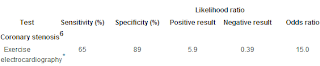


  • Sensitivity: This number tells you the probability that, if you have the disease that you are being tested for, the test will find the disease. It does not apply if you don’t have the disease. Think of it in terms of a car alarm: if someone is breaking into your car in the parking lot, what is the probability that your car alarm will go off? Probably very high – I would guess the car alarm would go off maybe 95% of the time someone is trying to break into your car. The 95% number is Sensitivity. Medical tests typically have high sensitivity – in the tests listed, they average about 70% – it is 65% for the test in the above example. If you have coronary stenosis, and are tested for it by electrocardiography, the test will register a positive result 65% of the time. That means that if you have coronary stenosis, there is a 35% probability this test will fail to find it.

  • Specificity: This is the probability that, if you DO NOT have the disease that you are being tested for, the test will register a negative result (that is, the correct result). This is a little complicated, because of the double negatives, but it is very important in terms of mental health. This number is rarely reported by doctors, and there have been studies that show they don’t really understand it well. YOU will understand it. You must understand it.

    The tests listed have good specificity, and the one in my example above is very good – many tests do not discriminate this well. If a test has a specificity of 89% (like the one above), that means that if you don’t have coronary stenosis, there is still a 11% chance that it will tell you that you actually have the disease. Got that? You go into the test totally disease-free – there is a 1 in 9 chance that your doctor will tell you the test came up positive. ALL tests have this problem, and most tests have specificity rates much lower than 89%. If you ever get a positive result, DO NOT PANIC. Wait until the second test result, and then panic (second tests are usually much more accurate – and expensive, which is why they don't use them the first time).

    Using the car alarm analogy, specificity is the probability that if no one is trying to steal your car, the car alarm will stay silent. But car alarms go off all the time, for no reason at all. Car alarms have poor specificity.
Those two numbers come from the perspective of the disease: IF you have the disease, or IF you are disease-free, what is the probability the test will give you the correct result? The next two numbers come from the other perspective: IF you have a test result, what is the probability that the test result is correct?
  • Positive Likelihood, or Positive Predictive Value (PPV): This is the odds (or probability) that, if your test results come up positive, that you actually have the disease. The numbers below are reported as odds, which are terrible numbers for humans to deal will, but it is a simple calculation to convert them to probabilities. The test above has a positive likelihood of 5.9, meaning that if you take a test and the results come back positive, it is 5.9 times more likely that you actually have the disease than not. In terms of probability

    Probability = Odds/(1+Odds) 
                = 5.9/(1+5.9) 
                = 86%

    That means there is a 86% chance that your positive test result is correct, and a 14% chance that it is wrong.

    There is a difference in the calculation of Positive Likelihood and Positive Predictive Value for some reason. To me, PPV is the more natural number: it is calculated by taking the number of people who actually had the disease AND tested positive (that is, the positive test result was correct) and dividing by the total number of people who tested positive (including those who didn't have the disease). In the scenario above, the 14% chance number is known as the false positive rate. In car alarm terms, the PPV is the probability that if your car alarm goes off that means someone is actually breaking into your car. As we know, car alarms have really low Positive Predictive Values, and high False Positive Rates. They go off all the time, and most of the time when they go off there is no one trying to break into them.

    However, Positive Likelihood is a little different. I won't explain the difference here (it's complicated to explain), but will just say that it reports an analogous number to PPV, and is apparently less sensitive to the prevalence of the disease. The two numbers are similar (after you covert Positive Likelihood from a ratio into a probability), and you really want to know that False Positve Rate.

    Note the difference between PPV (and Positive Likelihood) and Sensitivity. Sensitivity starts with the premise that someone is actually breaking into your car (i.e. you actually have the disease), and is telling you the probability that the alarm will go off (i.e. the test will return a positive result). PPV starts with the opposite premise, that your car alarm is already wailing away (i.e. you have a positive test result) and is telling you the probability that someone is actually breaking into your car (i.e. you actually have the disease).
  • Negative Likelihood, or Negative Predictive Value (NPV): This is the odds (or probability) that, if your test results come up negative, that you actually have the disease regardless. The tests listed have a negative likelihood of .39, meaning that if you take a test and the results come back negative there is still a 28% chance that you actually have the disease (odds of .39 is equal to a probability of .39/(1 + .39) = 28%) . This is known as the false negative rate, and like specificity it is poorly understood because of the negatives.

    (Again, note the difference in calcuation between Negative Likelihood and Negative Predictive Value, explained in the previous bullet. Both numbers are trying to tell you the same thing, even if they produce slightly different results.)

    In the car alarm analogy, NPV is the probability that, if your car alarm is silent, there is in fact someone breaking into your car, and that if you get a negative test result, you really have the disease. Note the similarity to Specificity which gives you the probability that if nobody is breaking into your car, your car alarm stays silent.
All of these numbers are known as conditional probabilities, meaning that they apply in certain conditions. People are not good at dealing with conditional probabilities – they want to know a test’s “accuracy”, and by that they mean overall accuracy. You can actually get that overall accuracy number (it is reported in the final column, the Odds Ratio), but it isn't important to us.

Because we know better: overall accuracy throws away information, information that you will have in your hand that will give you better understanding of what these tests are doing. The information you will have is the test results: if you have a positive test result, you don’t care about overall accuracy, you care about the tests accuracy on positive results – the positive predictive value. (Or its False Positive Rate, which is 1 minus PPV.)

Or maybe you don’t yet have the tests results, but from some personal experience or strange feelings in your gut, you have some indication or suspicion that you have the disease. In this case, you want to know the test’s sensitivity – the ability of the test to find the disease if you actually have it.

Here is a rule of thumb: if the proportion of people who DO NOT have a disease is higher than a test’s sensitivity, the test will generate more FALSE positives that TRUE positives. That is, if a test has a sensitivity of 90% (which is a pretty high sensitivity rate), but the rate of infection in a population is 5% (i.e. 95% of people are not infected with the disease), it will generate positive results which are more often incorrect than correct – in this particular case, 81% of the positive test results will be wrong! Almost all medical tests fall within these conditions – i.e. the rate of people who don’t have the disease will be higher than a test’s sensitivity. Think of the car alarm: the overwhelming percentage of the time the car alarm is turned on, no one is trying to break into the car. But the car alarm itself is very sensitive. This almost guarantees that if the car alarm go off, it will be a false alarm. Medical tests are not as sensitive as car alarms, and perhaps many diseases are more likely to happen than car thefts, but the principle is the same.

The point is, if you ever get a positive result, wait until the second test result. Ask your doctor about false positive rates. Most of all, don't panic until you know more. Most positive test results are WRONG.


UPDATE Wed 2:23 PM: Changed some text to indicate the differences between Likelihood Ratios and Predictive Values.

Monday, June 30, 2008

Let It Bleed

Let It Bleed
Track 5
"Let It Bleed" – 5:34


I've been carrying around this theory for a while, that there are some words that are impossible to sing without sounding silly: "politician", "dingleberry", and, as "Let It Bleed" proves, "breasts" – Mick gives it about 4 syllables and a couple of extra s'es, and generally makes it sound like he's never encountered the word in his life.

You all recognise the "Honky Tonk Woman" drum pickup at the start of the track. Ian Stewart, "the sixth Stone", fills in on piano. (I'll let you in on a secret: I have never liked his piano playing. This is exactly the kind of song Nicky Hopkins could've taken over, but instead we get Stewart's rudimentary honky tonk piano playing.) But who is playing that wicked slide guitar? Various sources tend to be unanimous: it's Keith, blowing me away, once again, with the breadth of his talent.

Sunday, June 29, 2008

Live with Me

Let It Bleed 
Track 4 
"Live with Me" – 3:36


[Download here.]

Huh. I always thought "Bitch" came first. Go figure.

That's the instantly-identifiable Bobby Keys on sax – I didn't even have to look it up, his sound is unmistakable. This is his first recording with the Stones, but not his last – he will go on to play on virtually every album that follows, along with most of their tours.

That Charlie Watts four-on-the-floor really kicks ass. Mick really has his slur working. That Keith harmony in the verses is a neat touch. But overall, this is another one of those songs I've always loved but couldn't really explain why.